
CASE STUDY
SupaTags
Take the money. Print the label. Never lose the order.
SECTOR — E-COMMERCE & FULFILMENT · STACK — NEXT.JS 15 · REACT 19 · SUPABASE · SCALE — LIVE, TAKING REAL MONEY · CLIENT — UK NAME-LABEL BRAND · BUILT — SOLO, UNDER TWO MONTHS
§ PROBLEM
A UK school name-label brand needed two things that are usually two products and three vendors: a shop where a parent designs a sheet of labels in under a minute, and the fulfilment operation that turns that order into a booked Royal Mail parcel. Between them sits the part nobody demos — money that has already moved, and a warehouse that has to agree with the ledger.
§ THE BUILD
One system, front to back. The design studio runs in the browser: text, fonts, colours, icons, photo upload, and generated sticker art. Photo cutout runs on the customer's own device — background removal in a Web Worker over WASM or WebGPU, with a custom alpha-matte refinement pass, a main-thread fallback, and a kill switch — so personalising a photo costs nothing per image and no picture of a child leaves the browser to be processed. Payment is Stripe hosted Checkout over a two-phase order: written pending_payment, promoted to paid only by a signature-verified webhook, with idempotency enforced by conditional update and a reconciliation endpoint that recovers the order if the webhook never lands. Refunds share one code path for full and partial, with a cumulative ratchet so a replayed webhook collapses to nothing. Shipping talks to Royal Mail Pro Shipping v4 — token caching, label PDFs, pre-manifest cancellation, end-of-day manifesting — and scopes every allocation to its own container so a second platform sharing the same Royal Mail account cannot claim our shipments. Behind it all, an admin floor: orders, staged fulfilment, label booking, manifests, refunds, catalogue, promo codes, and a switch that closes the shop.
§ OUTCOME
A shop and a warehouse that hold the same truth, live and taking money. Around 26,400 lines of TypeScript on Next.js 15, React 19 and Supabase, with row-level security as the boundary and isolated production and development environments that fail closed. Designed, built and shipped by one engineer in under two months.
STILLS FROM THE DEVELOPMENT DEPLOYMENT · PICK A STEP TO JUMP TO IT
FEATURE SET
01
The design studio
A parent opens a product and lays out a sheet of labels in the browser: text, fonts, colours, icons, uploaded photos and generated sticker art. No plugin, no upload-and-wait, no proof cycle. What they arrange on the sheet is what the printer receives.
IN-BROWSER CANVAS · CLIENT-SIDE RENDER · PRINT-READY OUTPUT
02
On-device photo cutout
Background removal runs on the customer's own machine — a Web Worker over WASM or WebGPU, a custom alpha-matte refinement pass, a main-thread fallback and a kill switch. Personalising a photo costs nothing per image, and no picture of a child leaves the browser to be processed.
ONNX IN A WEB WORKER · WASM OR WEBGPU · ZERO PER-IMAGE COST
03
The two-phase order
An order is written pending_payment before the customer ever reaches Stripe, and promoted to paid only by a signature-verified webhook. Idempotency is enforced by conditional update, so a replayed event changes nothing, and a reconciliation endpoint recovers the order when the webhook never arrives.
PENDING_PAYMENT → PAID · WEBHOOK-DRIVEN · CONDITIONAL UPDATE
04
The refund ratchet
Full and partial refunds share one code path, and the refunded total only ever moves up. A duplicated or out-of-order webhook collapses to nothing instead of paying a customer twice.
ONE CODE PATH · CUMULATIVE · REPLAY-SAFE
05
Container-scoped allocation
Shipping speaks Royal Mail Pro Shipping v4: cached tokens, label PDFs, pre-manifest cancellation, end-of-day manifesting. Every allocation is scoped to its own container, so a second platform sharing the same Royal Mail account cannot claim our shipments.
ROYAL MAIL PRO SHIPPING v4 · SCOPED CONTAINERS
06
The admin floor
One place to run the business: orders, staged fulfilment, label booking, manifests, refunds, catalogue and promo codes, and a switch that closes the shop. Reach is enforced by row-level security rather than by an unlisted route.
ROW-LEVEL SECURITY · STAGED FULFILMENT · SHOP KILL SWITCH
07
Guest order tracking
Most parents buy once, in a hurry, and will not open an account to do it. An order can be found and followed to the parcel without one.
NO ACCOUNT REQUIRED
SURFACES
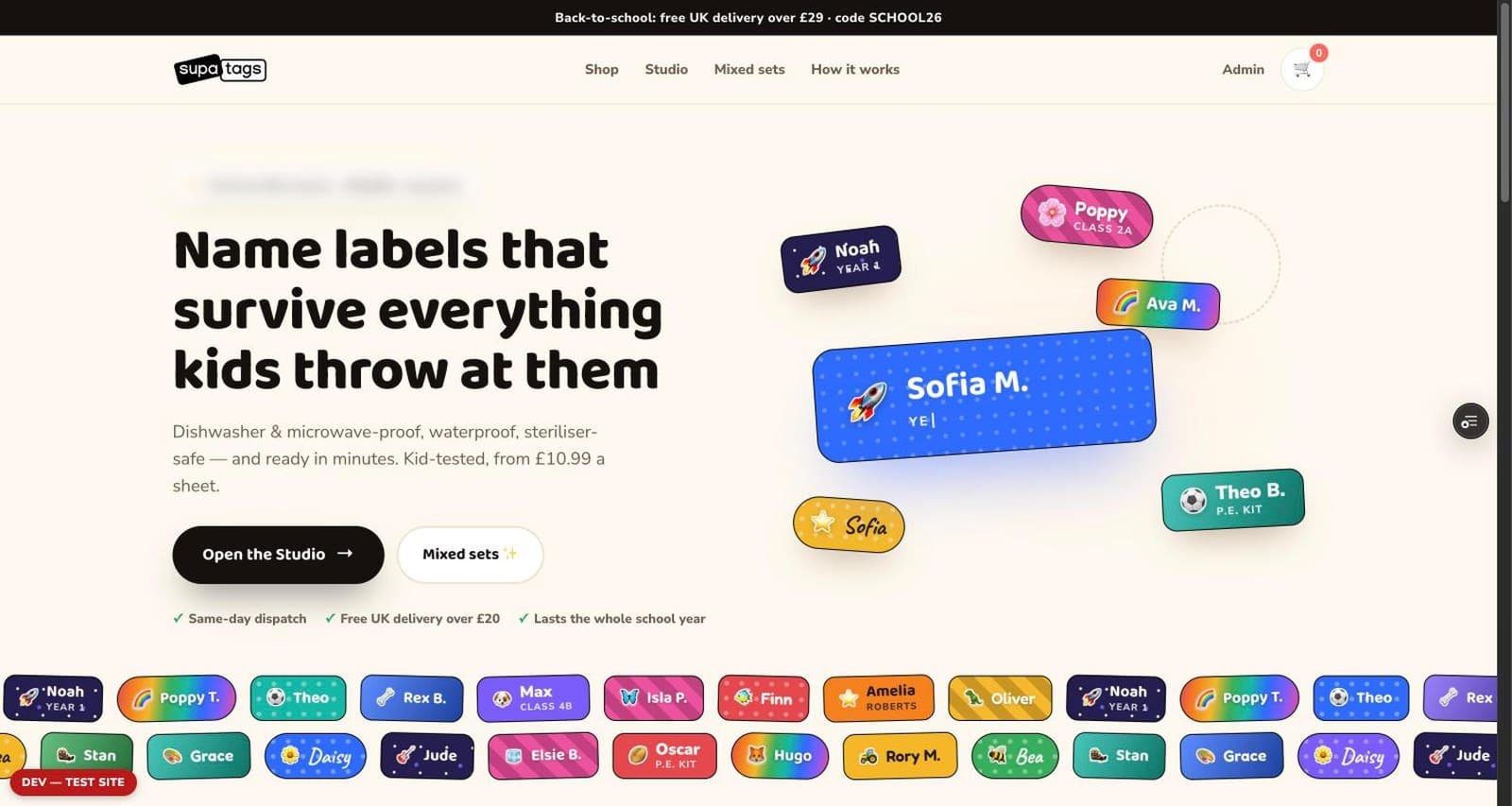
THE STOREFRONT — ONE PRICE, ONE WAY IN
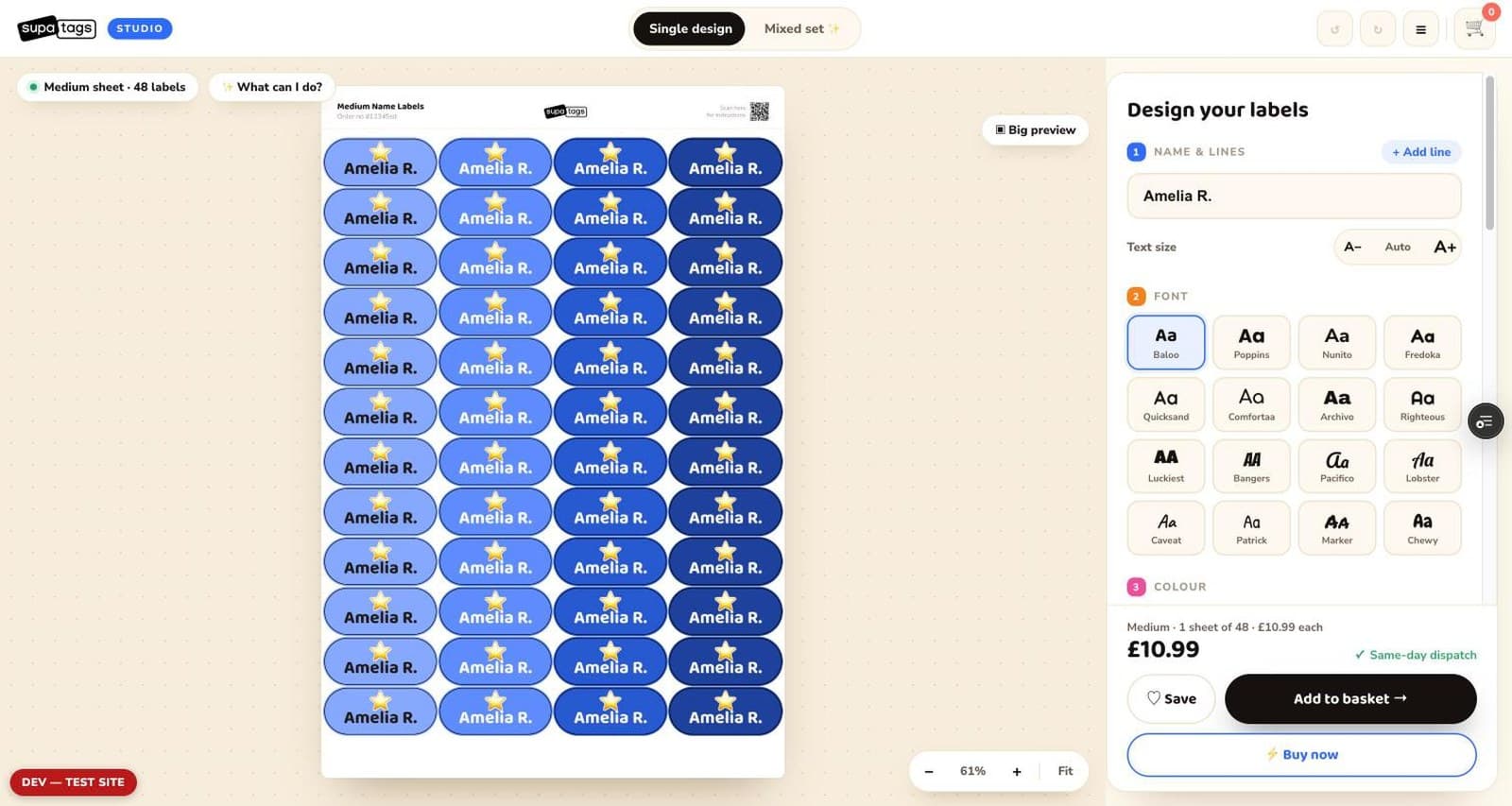
THE STUDIO — FORTY-EIGHT LABELS, LAID OUT LIVE
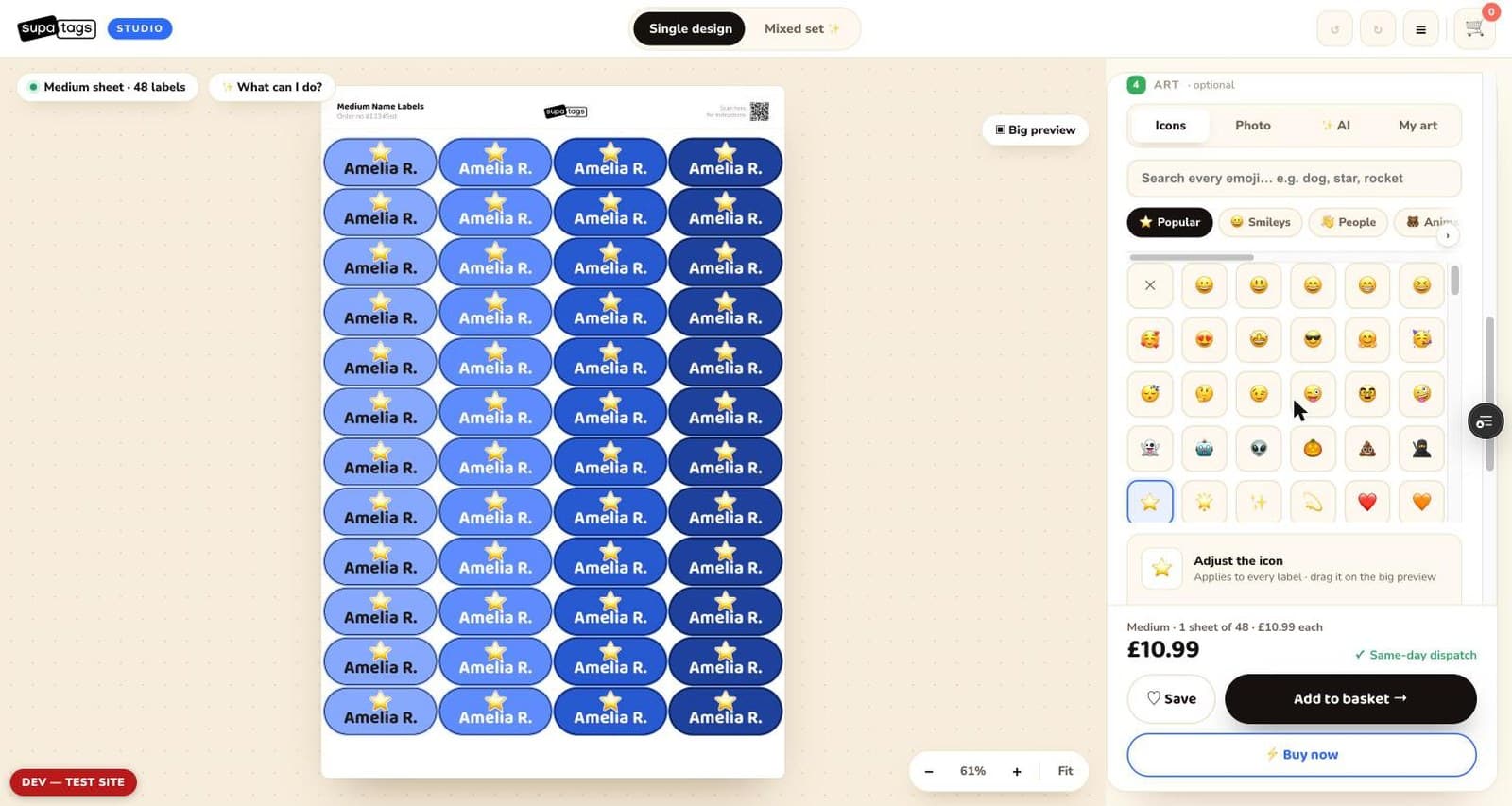
ART — FOUR SOURCES, ONE PLACEMENT
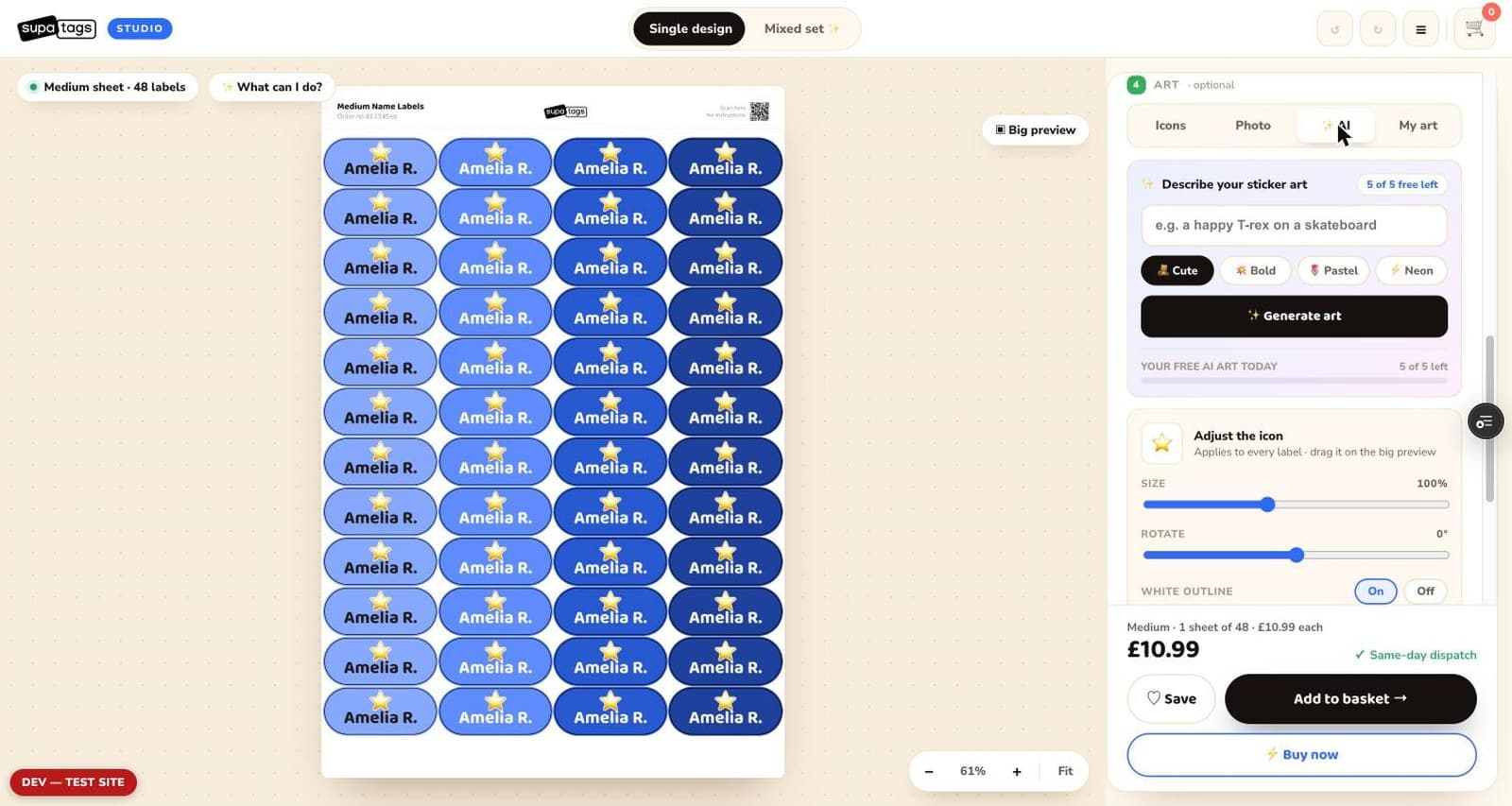
GENERATED ART — METERED, NOT UNLIMITED
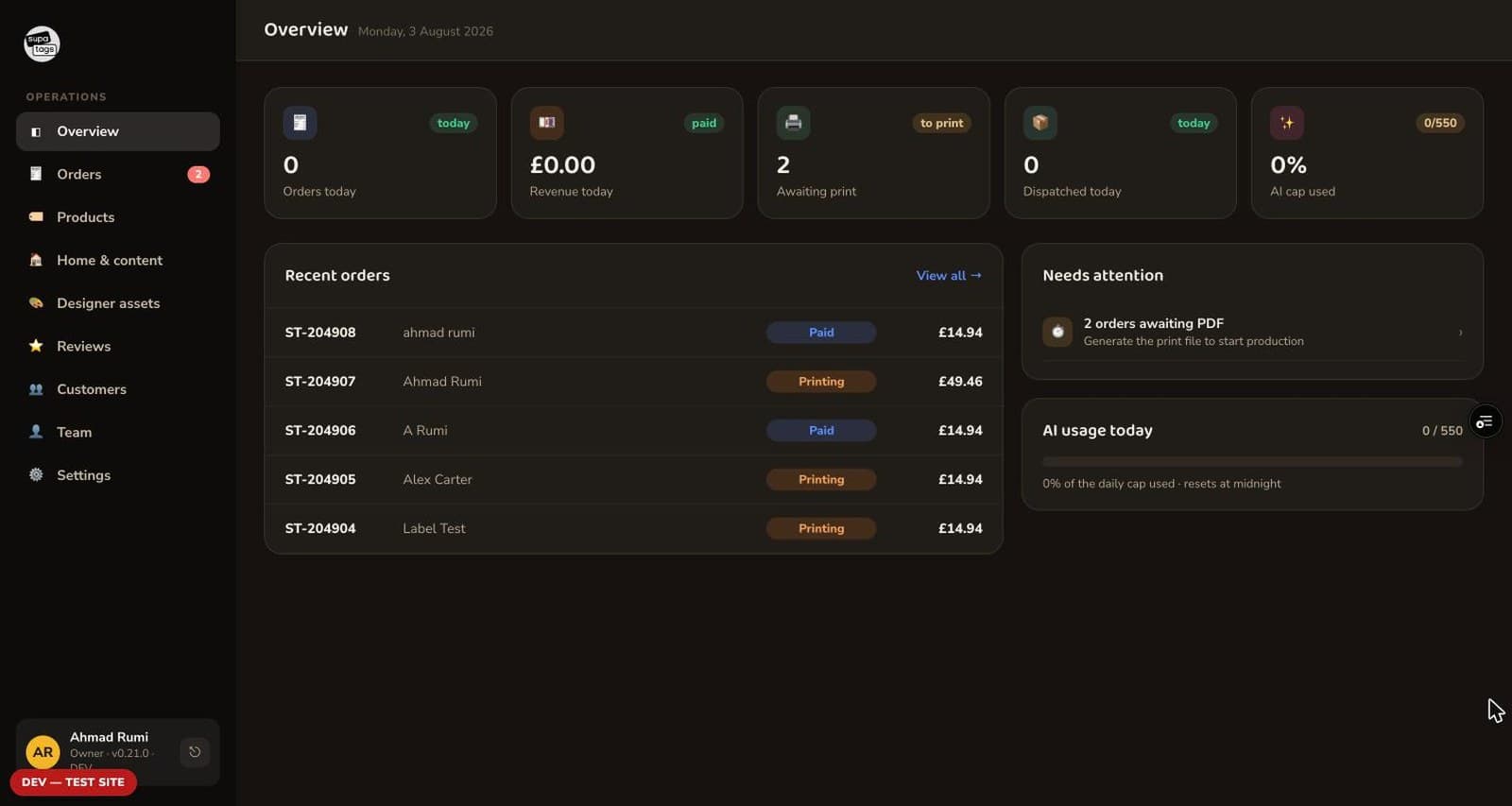
THE FLOOR — WHAT MOVED TODAY, WHAT IS STUCK
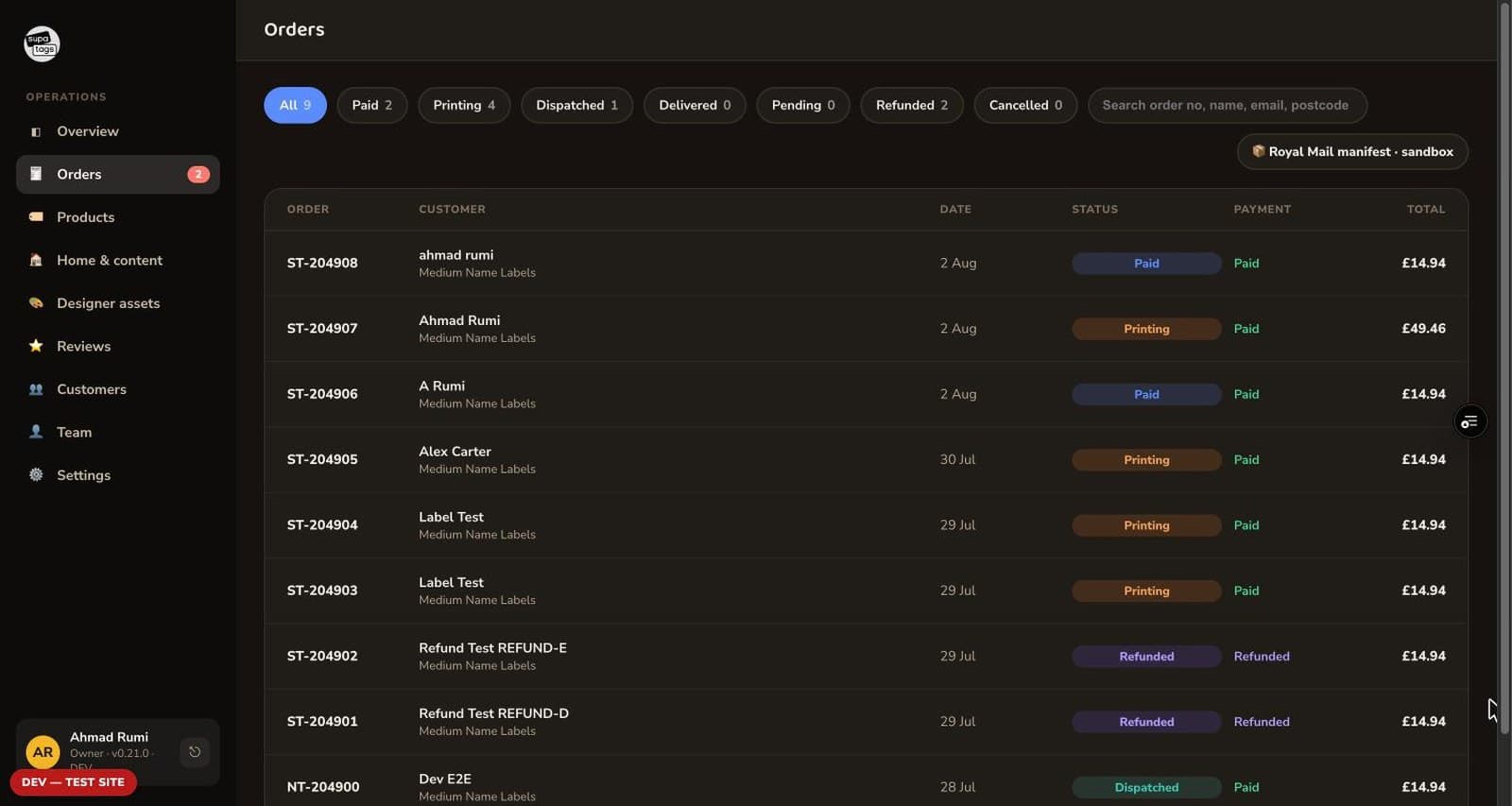
EVERY ORDER BY STATE · MANIFEST ON THE SAME SCREEN
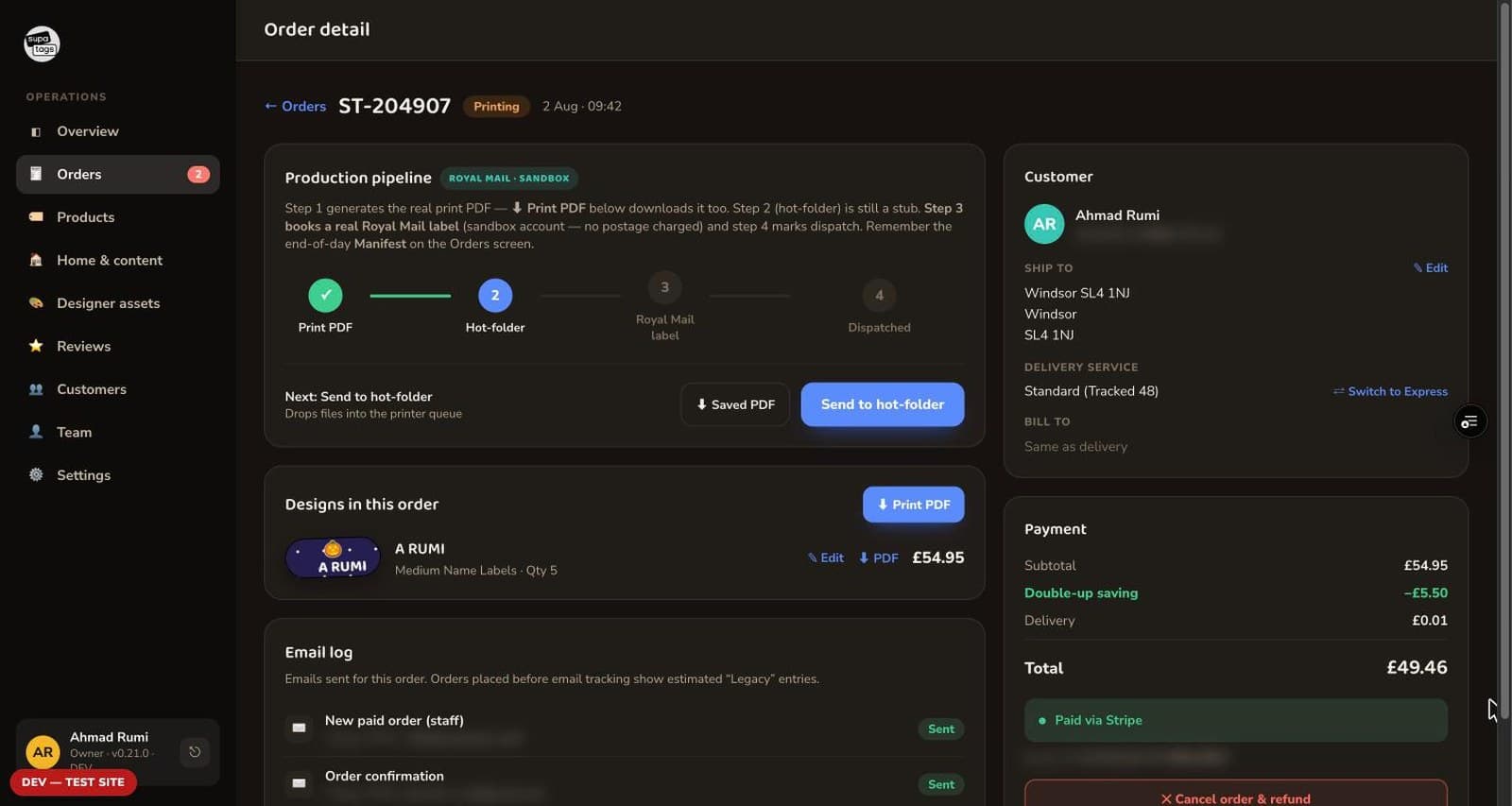
PRODUCTION — FOUR STAGES, ONE ORDER
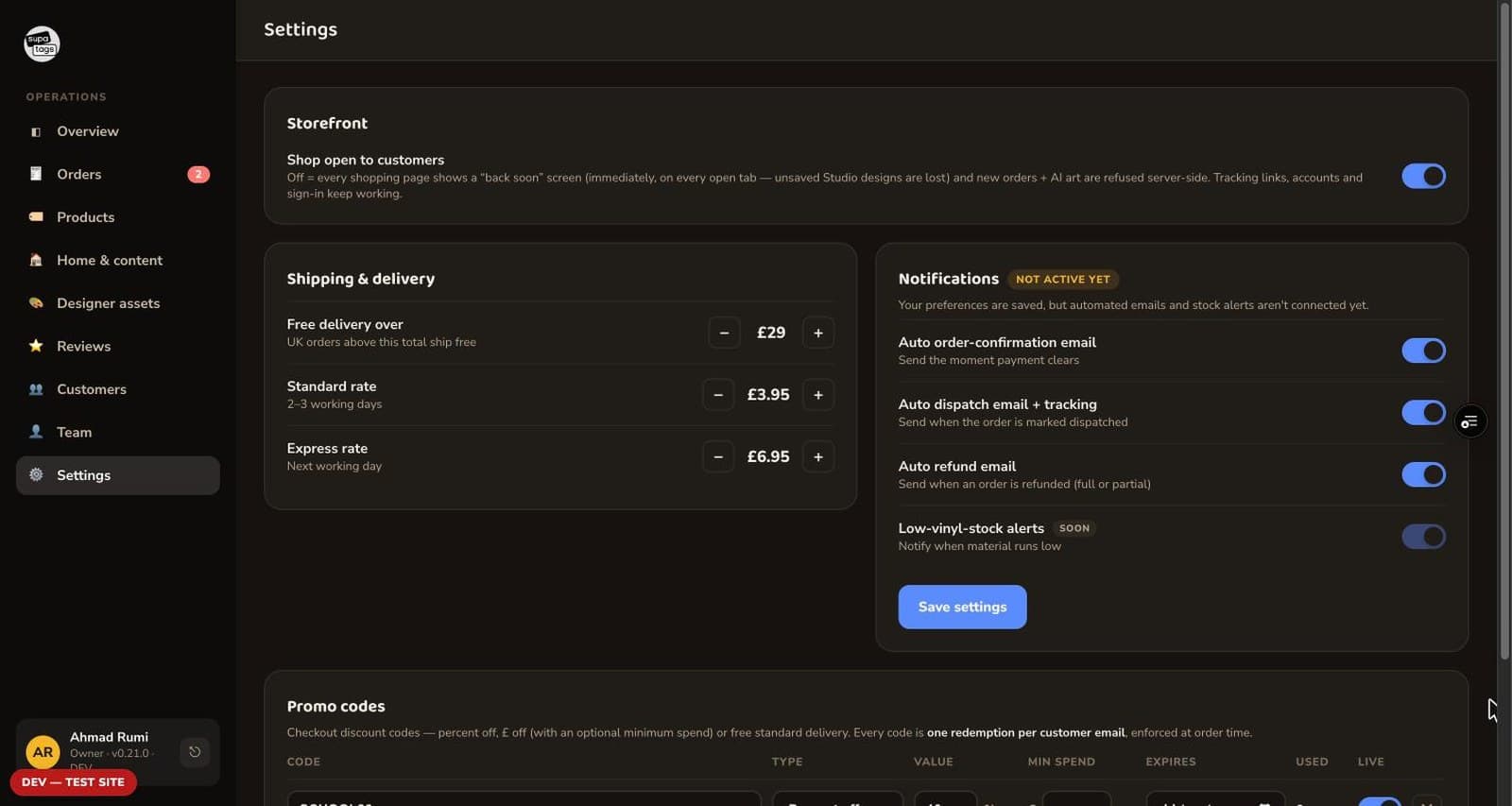
THE SWITCH THAT CLOSES THE SHOP
SYSTEM ANATOMY
THE STACK — AS BUILT
- CLIENT
- Next.js 15 · React 19 · TypeScript front to back
- DATA
- Supabase Postgres · row-level security as the boundary
- PAYMENTS
- Stripe hosted Checkout · signature-verified webhooks
- SHIPPING
- Royal Mail Pro Shipping v4 · cached tokens, label PDFs, manifests
- IMAGING
- On-device ONNX in a Web Worker · WASM or WebGPU, main-thread fallback
- Resend · order, dispatch and refund mail
- HOSTING
- Vercel · isolated production and development, failing closed
BUILD RECORD
PHASE 01
The studio
The surface a parent actually touches, built first: text, fonts, colours, icons, photo upload and generated sticker art, all in the browser. Photo cutout was on-device from the start — a Web Worker over WASM or WebGPU, a custom alpha-matte refinement pass, a main-thread fallback and a kill switch.
PHASE 02
Money
Stripe hosted Checkout over a two-phase order. Written pending_payment, promoted to paid only by a signature-verified webhook, idempotent by conditional update, with a reconciliation endpoint for the day the webhook never lands.
PHASE 03
Parcels
Royal Mail Pro Shipping v4 — token caching, label PDFs, pre-manifest cancellation, end-of-day manifesting. Every allocation scoped to its own container, so a second platform on the same Royal Mail account cannot claim our shipments.
PHASE 04
The admin floor
Orders, staged fulfilment, label booking, manifests, refunds, catalogue and promo codes, plus a switch that closes the shop. The point at which the storefront and the warehouse started reading the same record.
EMPTY REPO TO TAKING REAL MONEY
LINES OF TYPESCRIPT, ONE AUTHOR
PHOTO CUTOUT, ZERO PER-IMAGE COST
WEBHOOK-DRIVEN ORDER STATE
NEXT SYSTEM
WINGSWINGS